
Women Dental College (WDC), Abbottabad
The Bachelor of Dental Surgery (BDS) program at Women Dental College (WDC), Abbottabad is a four-year undergraduate professional dental education program designed to prepare competent, ethical, patient-centered, and socially responsible dental graduates. The program is offered within the regulatory framework of the Pakistan Medical & Dental Council (PM&DC) and under the academic affiliation of Khyber Medical University (KMU).
Following an annual academic and examination structure, the program provides progressive opportunities to develop clinical skills, research awareness, and community-oriented practice. Learning is experience-based, blending theoretical concepts with simulation, laboratory work, case-based learning, and supervised patient care.
The BDS curriculum is designed to develop graduates across the seven core competencies mandated by the PM&DC:
"Khyber Medical University will be the global leader in health sciences academics and research for efficient and compassionate health care."
"To train and develop competent healthcare professionals through an ethical, innovative and culturally appropriate learning experience."
| KMU Vision Focus | WDC Mission Alignment | PMDC Competencies | Program Learning Outcomes | Curricular Evidence |
|---|---|---|---|---|
| Health sciences academics & research | Competent professionals through ethical, innovative & culturally appropriate learning | Knowledgeable; Scholar & Researcher; Critical Thinker | Biomedical, behavioral, clinical knowledge, research literacy & evidence-based care | PLOs, study guides, curriculum maps, research activities, blueprints |
| Efficient & compassionate healthcare | Clinical competence, professionalism, communication, teamwork & patient care | Skillful; Professional; Leader & Role Model | Clinical skills, diagnosis, treatment planning, ethics, empathy & collaboration | Clinical training records, logbooks, OSCE/OSPE blueprints, portfolios |
| Healthcare responsive to society | Community-oriented education addressing local needs & sociocultural contexts | Community Health Promoter; Professional; Critical Thinker | Preventive oral healthcare, public health, ethics & sociocultural sensitivity | Community learning records, outreach activities, feedback & evaluation reports |
| Date / Timeline | Academic Event / Activity |
|---|---|
| 16th February 2026 | Commencement of Classes (1st, 2nd, 3rd & Final Year BDS) |
| 16th – 20th February 2026 | Orientation Week |
| 14th – 30th March 2026 | Ramadan & Eid-ul-Fitr Vacations |
| 23rd March 2026 | Pakistan Day |
| 3rd April 2026 | Plantation Day (3rd & Final Year BDS) |
| 10th April 2026 | Plantation Day (1st & 2nd Year BDS) |
| 1st May 2026 | Labour Day |
| 13th May 2026 | Community Visit (2nd Year BDS) |
| 23rd – 31st May 2026 | Eid-ul-Adha Vacations |
| 8th – 13th June 2026 | Sports Week |
| 8th – 17th June 2026 | Mid-Term Examination (Final Year BDS) |
| 25th – 26th June 2026 | Ashura |
| 14th August 2026 | Independence Day |
| 26th August 2026 | 12th Rabi-ul-Awal |
| 3rd September 2026 | Trip (1st & 2nd Year BDS) |
| 6th September 2026 | Defence Day |
| 19th September 2026 | Trip (3rd & Final Year BDS) |
| 9th November 2026 | Allama Iqbal Day |
| 16th November 2026 | Professional Exam (2nd Year BDS) |
| 19th November 2026 | Professional Exam (1st Year BDS) |
| 19th Nov – 4th Dec 2026 | Send-up Examination (Final Year BDS) |
| 14th December 2026 | Professional Exam (3rd Year BDS) |
| 25th December 2026 | Quaid Day |
| 25th January 2027 | Professional Exam (Final Year BDS) |
* Note: The dates may change subject to the confirmation of all stakeholders.
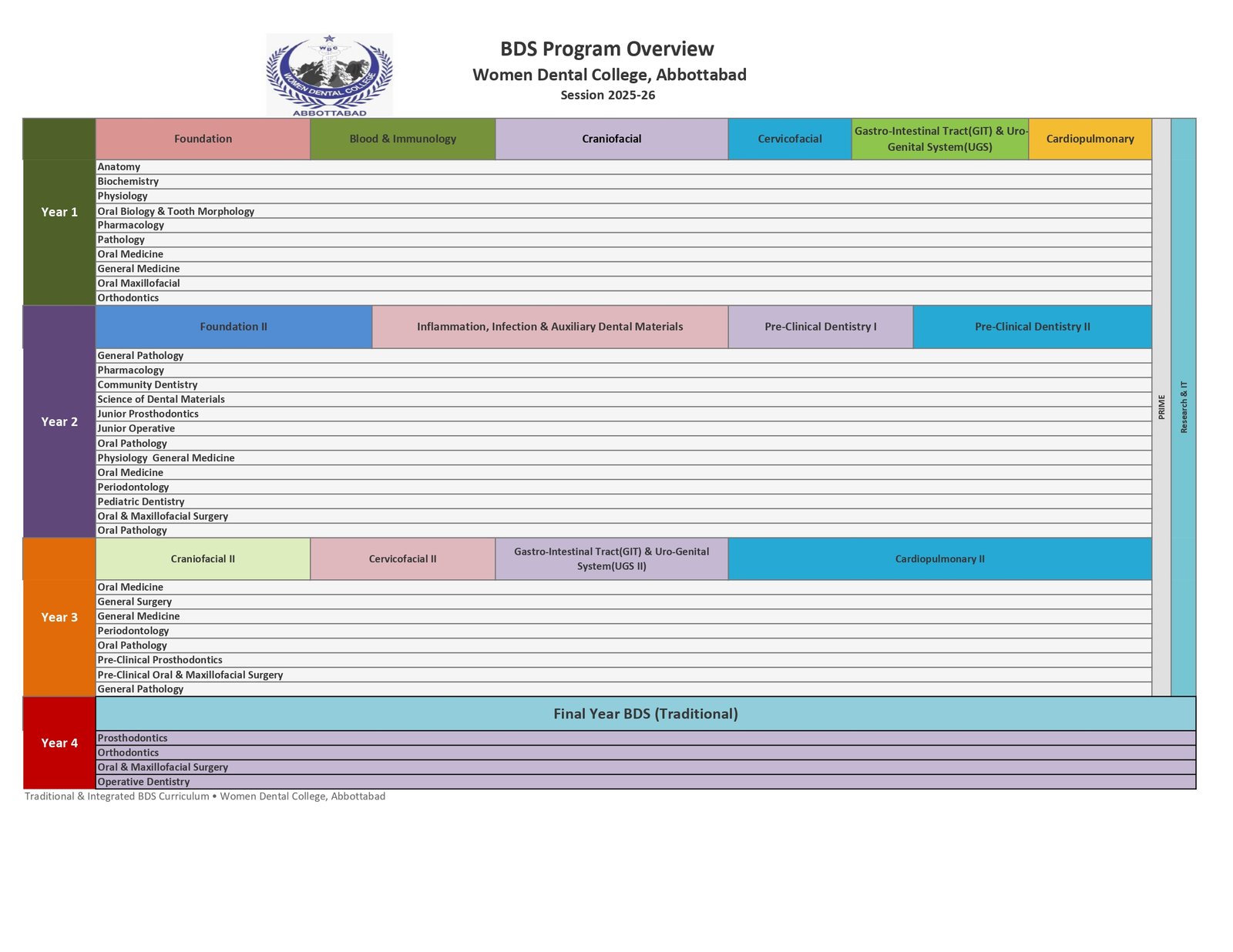
The BDS curriculum is delivered according to the approved curriculum framework applicable to each academic cohort, with modular integrated delivery adopted progressively and maintained as the standard model approved by the affiliating university and regulatory authority.
| Evaluation Area | Evidence / Mechanism | Use of Findings |
|---|---|---|
| Student Feedback | Course & teaching evaluations via LMS | Refine instruction, resources & clinical practice |
| Faculty Input | Departmental reviews & faculty surveys | Address operational challenges & development needs |
| Assessment Data | Item analysis & OSCE performance trends | Identify learning gaps & refine assessment tools |
| QEC Review | Quality indicators & institutional self-assessments | Maintain accreditation standards & continuous quality |